← The Rapture.NFT Project

THE REVELATION GUIDE

Read the book the way it asks to be read.

Revelation opens with a blessing on the person who reads it out loud, on the people who hear it, and on everyone who keeps it. It does not open with a code to crack. This guide walks the book in order, shows the Christ it describes, lays out the four ways the church has read it for two thousand years, and says plainly where the Rapture sits in the text. Three rules hold on every page: back to the source every time, every major tradition shown by name, and the images in this collection are imagination, not doctrine.

“Blessed is he that readeth, and they that hear the words of this prophecy, and keep those things which are written therein: for the time is at hand.”

REVELATION 1:3

HOW THE BOOK IS BUILT

Sevens, and a spiral.

Seven letters, seven seals, seven trumpets, seven bowls. Most commentators (Beale, Osborne, Mounce, Bauckham) see the seals, trumpets and bowls telescoping, the seventh of each opening the next. Futurists read them as one sequence of future events; idealists and most amillennial readers see the same age told three times with rising intensity. That one decision drives more of the imagery than any other. Below, the eleven blocks of the book in order. For each: what it says, who reads it literally and who reads it as symbol, what a painter would need, and which series of the collection pictures it.

BLOCK 1 · REVELATION 1
The vision of the Son of Man
1:1, 1:7, 1:10-11, 1:12-16, 1:17-18, 1:20

John, exiled on Patmos, hears a voice like a trumpet on the Lord's day and turns to see the risen Christ standing among seven golden lampstands. He falls as though dead; a hand is laid on him. The book names itself in its first line, the revelation of Jesus Christ, and gives the reader its first key in verse 20: the stars are the messengers of the churches, the lampstands are the churches.

“I am he that liveth, and was dead; and, behold, I am alive for evermore, Amen; and have the keys of hell and of death.”

REVELATION 1:18

SYMBOLIC OR LITERAL?The book itself says 1:20 is symbolic, so every school treats the stars and lampstands as symbols. The figure of Christ is real, but described in the language of Daniel 7 and Daniel 10, which all schools agree is vision language, not a portrait. PAINTER'S KITSeven golden lampstands, a long robe with a golden sash, hair white as wool, eyes like flame, feet like bronze in a furnace, a voice like many waters, seven stars in the right hand, a sharp two-edged sword from the mouth, a face like the sun at full strength, the keys of death and hell. Palette: gold, white, bronze, sun-glare. Setting: Patmos shore or cave. PICTURED INSeries IV, The Son of Man
BLOCK 2 · REVELATION 2-3
Letters to the seven churches
2:4, 2:10, 2:17, 3:1, 3:8, 3:15-16, 3:20

Before any prophecy, the book is mail. Seven short letters to seven real congregations on a postal circuit in Asia Minor: Ephesus, Smyrna, Pergamum, Thyatira, Sardis, Philadelphia, Laodicea. Each gets a word of praise or rebuke fitted to its city, and a reward for the one who overcomes: the tree of life, the crown of life, a white stone, hidden manna, the morning star, white garments, a pillar in the temple, a seat on the throne.

“Behold, I stand at the door, and knock: if any man hear my voice, and open the door, I will come in to him.”

REVELATION 3:20

SYMBOLIC OR LITERAL?All schools agree these were real cities and real churches. Two extras: an older dispensational reading (Scofield notes, some Dallas-tradition teachers) took the seven as seven successive ages of church history; most current commentators, including dispensational ones like Walvoord, hold that loosely or set it aside. And 3:10, the promise to keep Philadelphia from the hour of trial, is a Rapture proof text; see the table below. PAINTER'S KITSeven distinct cityscapes with local color: the temple of Artemis at Ephesus, the great altar of Pergamum, Laodicea's lukewarm aqueduct water and eye salve, Thyatira's purple dye, the acropolis of Sardis. The rewards as objects: tree, crown, white stone, manna, star, white robe, pillar, throne. The Speaker at a door. PICTURED INSeries V, Seven Churches
BLOCK 3 · REVELATION 4-5
The throne room, the scroll, the Lamb
4:1, 4:3, 4:6-8, 5:1, 5:5, 5:6, 5:9

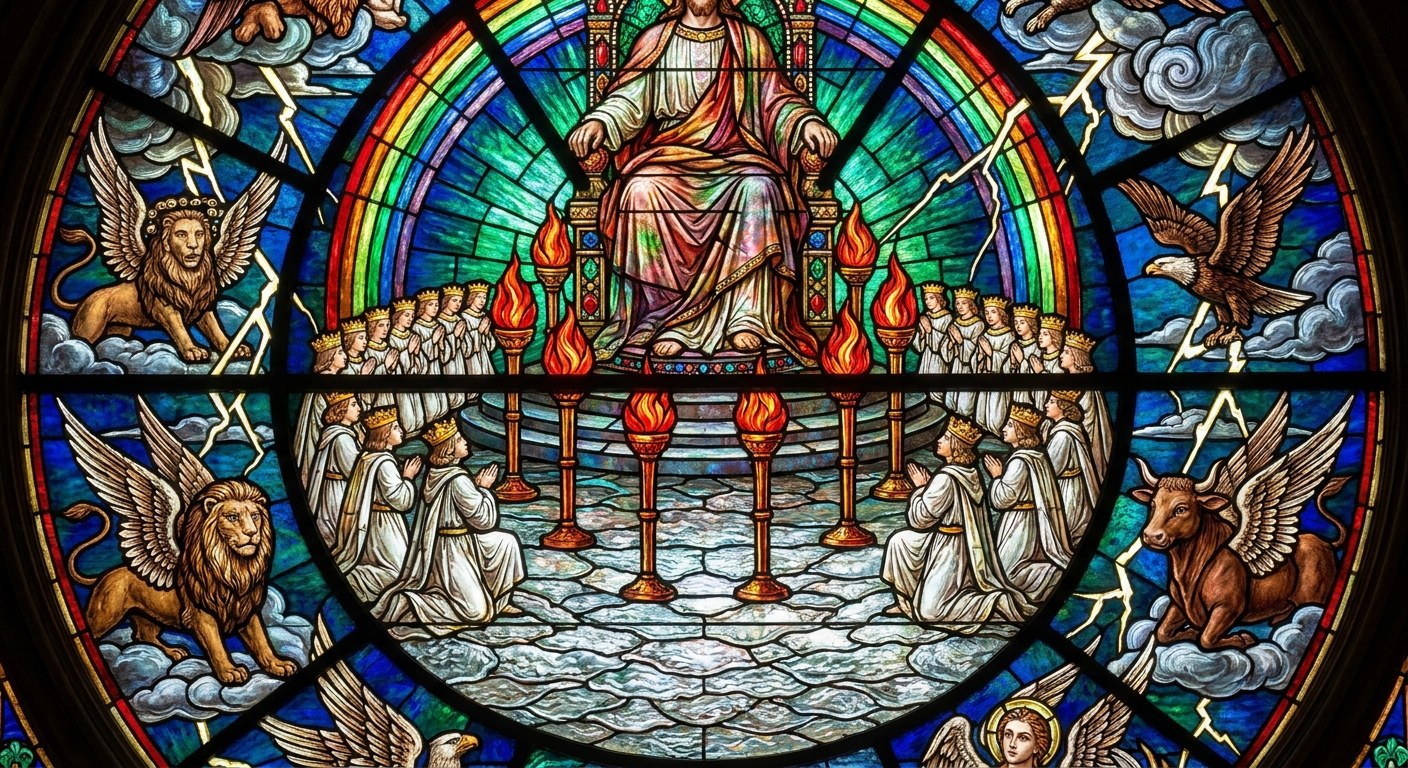
A door opens in heaven. John sees a throne ringed by an emerald rainbow, twenty-four elders in white with golden crowns, four living creatures full of eyes, a sea of glass like crystal, and a scroll sealed with seven seals that no one is worthy to open. John weeps. Then he is told to look at the Lion of the tribe of Judah, and what he sees is a Lamb standing as though it had been slain. The Lamb takes the scroll, and heaven sings a new song.

“Weep not: behold, the Lion of the tribe of Juda, the Root of David, hath prevailed to open the book.”

REVELATION 5:5

SYMBOLIC OR LITERAL?A heavenly liturgy scene in every school. The creatures, the twenty-four elders, the seven torches and the sea of glass are read as theophany imagery drawn from Ezekiel 1 and Isaiah 6. The elders are Israel plus the church (twelve and twelve) in most readings, angelic beings in some. PAINTER'S KITEmerald rainbow halo, sea of glass, twenty-four white-robed elders casting gold crowns down, four creatures (lion, ox, man, eagle; six wings; full of eyes), seven torches, a scroll written inside and out, lightning and thunder from the throne. Palette: emerald, crystal-white, jasper red, gold. The one on the throne is given only as jewel-color, so paint light, not a face. PICTURED INSeries VI, Throne Room
BLOCK 4 · REVELATION 6-8:1
The seven seals and the four horsemen
6:2, 6:4, 6:5-6, 6:8, 6:9-11, 6:12-14, 7:4, 7:9, 8:1

The Lamb opens the seals. Four riders go out: a white horse with a bow and a crown, a red horse with a great sword, a black horse with a pair of scales, a pale horse whose rider is Death with Hell following. Under the altar, the souls of the slain cry out how long. The sixth seal blackens the sun and rolls up the sky. Then a pause: 144,000 are sealed from the tribes of Israel, a multitude no one can number stands in white with palm branches, and the seventh seal opens onto half an hour of silence in heaven.

“And I looked, and behold a pale horse: and his name that sat on him was Death, and Hell followed with him.”

REVELATION 6:8

SYMBOLIC OR LITERAL?The horsemen are read as symbols of conquest, war, famine and death by everyone, with Zechariah 1 and 6 behind them. The rider on the white horse is disputed: a counterfeit Christ or Antichrist (Walvoord, MacArthur, many futurists, and Beale) or the advance of the gospel (Irenaeus and some older readings). The 144,000: literal Jewish evangelists from the twelve tribes (dispensational futurists) or the whole church as true Israel (Beale, Bauckham, most amillennial and many historic premillennial readers). The sixth-seal sky signs: literal (futurist) or the Old Testament's language for the fall of powers (idealist and preterist). PAINTER'S KITFour horses (white, fiery red, black, and pale grey-green, the Greek chloros), bow, sword, balance scales, Hell following. An altar with souls beneath and white robes handed out. A blackened sun, a blood moon, stars falling like figs, the sky as a rolled scroll. Angels holding four winds. A seal on foreheads. Palm branches. And the rarest quiet image in the book: half an hour of silence. PICTURED INSeries VII, Seven Seals
BLOCK 5 · REVELATION 8-11
The seven trumpets, the little scroll, the two witnesses
8:7-12, 9:1-11, 9:16, 10:9-10, 11:3, 11:7-12, 11:15

Seven angels sound seven trumpets. Hail and fire mixed with blood, a burning mountain thrown into the sea, a star called Wormwood, a third of the sun and moon and stars darkened. The fifth trumpet opens the bottomless pit and locusts pour out with human faces and gold crowns under a king named Abaddon. John is handed a little scroll and told to eat it: sweet in the mouth, bitter in the stomach. Two witnesses prophesy 1,260 days in sackcloth, are killed by the beast, lie in the street three and a half days, and rise at the words come up hither. The seventh trumpet sounds, and heaven declares the kingdom has changed hands.

“The kingdoms of this world are become the kingdoms of our Lord, and of his Christ; and he shall reign for ever and ever.”

REVELATION 11:15

SYMBOLIC OR LITERAL?The trumpets echo the plagues of Exodus. Futurists (Walvoord, MacArthur) take the ecological damage fairly literally, often with a third as a real proportion. The locusts are demonic in nearly every reading, since they come from the pit and have a king; the 1970s reading of them as attack helicopters (Hal Lindsey) is rejected by commentators of every school, futurist included. The two witnesses: two literal end-time prophets, often Moses and Elijah or Enoch and Elijah, because the signs match (the futurist majority); or the witnessing church in its prophetic role, since two lampstands are two churches by the key in 1:20 (Beale, Bauckham, most idealists). The 1,260 days, 42 months, and time, times and half a time recur through chapters 11 to 13: a literal three and a half years (futurist) or a symbol for the whole age of pressure between the two comings (idealist). PAINTER'S KITSeven angels with trumpets, a censer hurled to earth, a burning mountain, a falling star, darkened thirds of sky, smoke from a shaft, locust cavalry with lions' teeth and iron breastplates and scorpion tails, riders in breastplates of fire and sapphire and sulphur, a mighty angel wrapped in cloud with a rainbow on his head and legs like pillars of fire straddling sea and land, a tiny open scroll, two figures in sackcloth beside two olive trees and two lampstands, fire from their mouths, bodies in a street, a cloud ascension, an earthquake, and the temple in heaven opened with the ark visible (11:19). PICTURED INSeries VIII, Seven Trumpets, and Series IX, Two Witnesses
BLOCK 6 · REVELATION 12-14
The woman, the dragon, the two beasts, the mark
12:1, 12:3, 12:5, 12:7-9, 13:1-2, 13:3, 13:11, 13:16-18, 14:1, 14:14-20

The book steps behind the curtain. A woman clothed with the sun gives birth to a male child who will rule with a rod of iron; a great red dragon with seven heads waits to devour him. War in heaven, Michael against the dragon, and the dragon is thrown down and named: that old serpent, the Devil. He raises two beasts, one from the sea with the parts of a leopard, a bear and a lion, one from the earth with two horns like a lamb and the voice of a dragon. Everyone must take a mark on the right hand or forehead to buy or sell, and the number of the beast is given as 666. Against them stand the Lamb on Mount Zion with the 144,000, three flying angels, and two harvests: grain gathered in, and grapes trodden in the winepress of God's wrath.

“Here is wisdom. Let him that hath understanding count the number of the beast: for it is the number of a man.”

REVELATION 13:18

SYMBOLIC OR LITERAL?Symbolic in every school; the argument is over what the symbols point to. The woman: Israel (most evangelicals), the church, Mary (Catholic tradition), or the people of God across both covenants (Beale). The dragon is Satan by the text's own word (12:9). The beast from the sea: a future personal Antichrist heading a world empire (the futurist and majority evangelical view); Rome and her emperors, often Nero (preterists such as Gentry and Chilton, and many critical scholars); or the state whenever it demands worship (idealists such as Beale and Hendriksen). The beast from the earth, the false prophet, is the religious propaganda arm of the first in every school. 666: the Hebrew letter-count of Nero Caesar, which also explains the ancient variant 616 (a preterist and critical mainstay that many evangelicals accept at least as the first-century reference); falling short of seven, the number of completeness (Beale); or a future identifier or implant (popular futurist). The mark on hand and forehead is a parody of God's seal on his people in 7:3 and Deuteronomy 6:8. PAINTER'S KITA sun-robed woman with the moon under her feet and twelve stars on her head; a seven-headed red dragon sweeping a third of the stars with its tail; a wilderness refuge on eagle's wings; a river from the serpent's mouth swallowed by the earth; the sea-beast composite with ten crowned horns and a healed head wound; the earth-beast with lamb's horns; an image that speaks; fire from heaven as a counterfeit sign; the number; Zion with harpists; three flying angels; sickles; a winepress. Palette: red, sea-grey, sun-gold, harvest gold, wine-dark. PICTURED INSeries X, The Dragon and the Beasts (with the Rev 14 harvests)
BLOCK 7 · REVELATION 15-16
The seven bowls
15:2-3, 16:2, 16:3-4, 16:8, 16:10, 16:12, 16:13, 16:16, 16:17, 16:21

Beside a sea of glass mingled with fire, the conquerors sing the song of Moses and of the Lamb. Then seven angels in linen with golden sashes pour out seven bowls: sores on those who carry the mark, the sea and the rivers turned to blood, the sun scorching, the beast's kingdom plunged into darkness, the Euphrates dried so the kings of the east can cross, three unclean spirits like frogs gathering the kings of the earth to a place called Armageddon. A voice from the throne says it is done. The great city splits in three, and hailstones the weight of a talent fall.

“And there came a great voice out of the temple of heaven, from the throne, saying, It is done.”

REVELATION 16:17

SYMBOLIC OR LITERAL?The bowls intensify the trumpets (thirds become totals) and echo Exodus again. Futurists: literal judgments in the final year. Preterists: the fall of Jerusalem in AD 70, or of Rome. Idealists: the final form of God's judgment on the beast's world. Armageddon, the mount of Megiddo: a literal battlefield on the plain of Jezreel (futurist), or a symbol for the last confrontation, since Megiddo has no mountain (Beale; Osborne notes both). PAINTER'S KITSeven angels in linen with golden sashes, golden bowls, a temple filled with smoke, a sea of glass with fire in it, boils, blood seas, a scorching sun, darkness, a dry Euphrates riverbed, frog-spirits, gathering armies, lightning, a city split in three, hail. PICTURED INSeries XI, Seven Bowls and Babylon
BLOCK 8 · REVELATION 17-18
Babylon the Great
17:3-5, 17:6, 17:9, 17:16, 18:2, 18:11-17, 18:21

An angel carries John into the wilderness to see a woman in purple and scarlet, seated on a scarlet beast with seven heads, holding a golden cup, drunk with the blood of the saints, and wearing a name on her forehead: Mystery, Babylon the Great. The seven heads are seven hills. The beast she rides will turn on her and burn her. Then the fall: in a single hour the great city is gone, and the merchants and sea captains who grew rich on her stand far off and weep over the cargo list, which ends with slaves, and the souls of men. A mighty angel throws a millstone into the sea; there will be no more music, no more millwork, no more lamplight.

“Babylon the great is fallen, is fallen, and is become the habitation of devils.”

REVELATION 18:2

SYMBOLIC OR LITERAL?Babylon is a cipher in every school, and John says so (17:5, a name of mystery; 17:18, the great city). Rome, on seven hills, is the near-universal first-century referent and is accepted by most commentators of all schools at least as the primary image. Jerusalem: Gentry, Chilton and other preterists, reading the great city back from 11:8. A rebuilt literal Babylon in Iraq: Walvoord, Charles Dyer, some futurists. The world's system of commerce, luxury and idolatry in every age: idealists, and Bauckham's economic critique of Rome. PAINTER'S KITA woman in purple and scarlet on a scarlet seven-headed beast, a jeweled gold cup, a forehead inscription, a wilderness, seven hills, ten kings, a burning city seen from ships at sea, merchants and captains weeping, a cargo still-life (gold, silver, jewels, pearls, fine linen, purple, silk, scarlet, ivory, spices, wine, oil, horses, chariots), an angel with a millstone, the silence of harps and mills and lamps. Dignity note: the prostitute image is a prophetic metaphor for idolatry, as in Hosea and Ezekiel 16 and 23. Paint opulence and enthronement, never sexualized figures. PICTURED INSeries XI, Seven Bowls and Babylon
BLOCK 9 · REVELATION 19
Hallelujah, the marriage supper, the Rider
19:6-7, 19:8, 19:9, 19:11-16, 19:17-18, 19:20

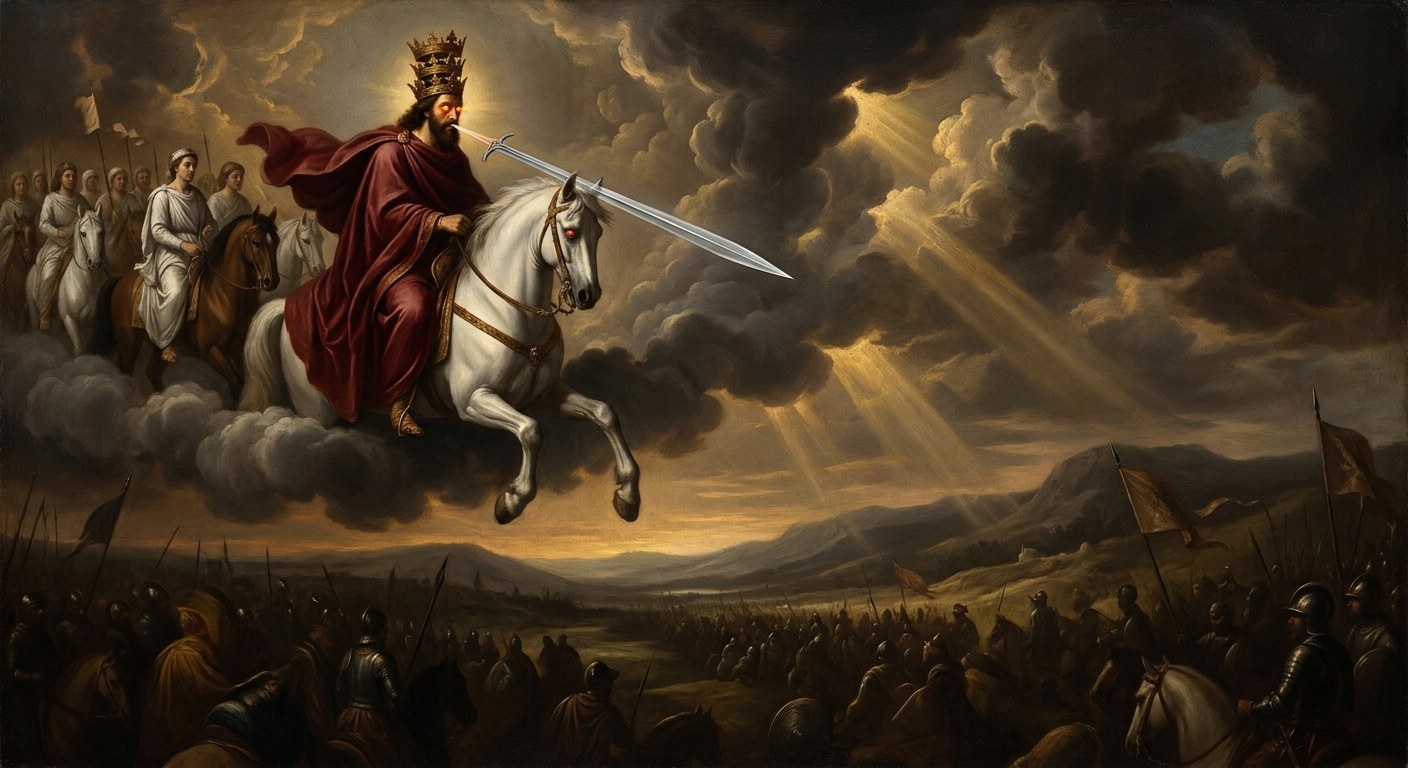
Heaven roars hallelujah, the Lord God omnipotent reigns, and the marriage of the Lamb has come; his bride has made herself ready in bright, clean linen, which the text says is the righteous deeds of the saints. Then heaven opens and a white horse comes out. Its Rider is called Faithful and True, his eyes are a flame of fire, he wears many crowns and a name no one knows, his robe is dipped in blood, a sharp sword goes out of his mouth, and on his robe and thigh is written King of Kings and Lord of Lords. The armies of heaven follow on white horses. A second supper is called, for the birds, and the beast and the false prophet are taken and thrown alive into the lake of fire.

“And he hath on his vesture and on his thigh a name written, KING OF KINGS, AND LORD OF LORDS.”

REVELATION 19:16

SYMBOLIC OR LITERAL?The return itself is literal and bodily in every evangelical school. The sword from the mouth, the blood-dipped robe and the birds' feast are symbols of the Word's judgment, not a gore scene; even Walvoord says the sword is the Word. Timing: pre-tribulation futurists place the marriage supper in heaven during the tribulation; post-tribulation and amillennial readers place it at the consummation. PAINTER'S KITTwo suppers set deliberately against each other (the bride's feast, the birds' feast), a white horse, a Rider with many crowns and fire for eyes, a robe dipped in blood, a sword from the mouth rendered as light or Word, armies of heaven in white linen on white horses, an angel standing in the sun, an iron rod, a winepress. PICTURED INSeries XII, King of Kings
BLOCK 10 · REVELATION 20
The thousand years, Gog and Magog, the great white throne
20:1-3, 20:4, 20:5-6, 20:7-9, 20:10, 20:11, 20:12, 20:14

An angel with a key and a great chain binds the dragon for a thousand years. Thrones are set, and those beheaded for their witness come to life and reign with Christ; this is the first resurrection. When the thousand years end, Satan is loosed, gathers Gog and Magog from the four corners of the earth against the beloved city, and fire comes down from heaven. The devil joins the beast and false prophet in the lake of fire. Then a great white throne, before which earth and sky flee; the dead, small and great, stand before God; the books are opened, and another book, which is the book of life; and death and hell are thrown into the lake of fire, which is the second death.

“And I saw the dead, small and great, stand before God; and the books were opened: and another book was opened, which is the book of life.”

REVELATION 20:12

SYMBOLIC OR LITERAL?The dividing passage for the millennial views. Premillennial (a real future reign after the return, whether 1,000 literal years or a long era): Walvoord, MacArthur, Ladd, Mounce, Osborne. Amillennial (the thousand years is the present age between the two comings, Satan bound from deceiving the nations, the saints reigning now in heaven): Beale, Storms, Hendriksen, Riddlebarger. Postmillennial (a golden age produced by the gospel's success before Christ returns): Gentry, Chilton, and older Reformed voices like Edwards and Hodge. Gog and Magog from Ezekiel 38 and 39: literal nations (futurist) or the whole of hostile humanity (idealist). The great white throne is the literal final judgment in every school. PAINTER'S KITAn angel with a great chain and key, a sealed pit, thrones, a thousand years shown as a calendar or tree rings or generations or long-exposure light, nations at the four corners ringing the beloved city, fire from heaven, a white throne so bright that earth and sky flee, open books, the book of life, a lake of fire, Death personified and cast down. PICTURED INSeries XII, King of Kings, as a Revelation 20 bridge set carrying the three millennial readings on its cards
BLOCK 11 · REVELATION 21-22
New heaven, new earth, New Jerusalem, the invitation
21:1, 21:2, 21:3-4, 21:6, 21:16, 21:18-21, 21:22-23, 22:1-2, 22:4, 22:16, 22:17, 22:20

A new heaven and a new earth, and no more sea. The holy city comes down from God like a bride adorned for her husband. God himself dwells with his people and wipes away every tear; no more death, sorrow, crying or pain. The city is measured as a cube, twelve thousand furlongs each way, with walls of jasper, twelve foundation stones of twelve gems, twelve gates each a single pearl, and streets of gold clear as glass. There is no temple, because God and the Lamb are its temple, and no sun, because the Lamb is its lamp. A river of the water of life runs down the middle of the street with the tree of life on both banks, its leaves for the healing of the nations. They shall see his face. The book ends with a bride saying come, and a Lord saying surely I come quickly.

“And God shall wipe away all tears from their eyes; and there shall be no more death, neither sorrow, nor crying, neither shall there be any more pain.”

REVELATION 21:4

SYMBOLIC OR LITERAL?A literal renewed cosmos and a literal city (the futurist majority and many premillennialists); or the city as the redeemed people themselves, the bride, with the cube echoing the Holy of Holies (Beale, Bauckham; and common among premillennialists too for the measurements). Sources behind the vision: Ezekiel 40 to 48, Isaiah 60, Genesis 2. PAINTER'S KITA descending cube-city; twelve gates, each a single pearl bearing a tribe's name; twelve foundations of jasper, sapphire, chalcedony, emerald, sardonyx, sardius, chrysolite, beryl, topaz, chrysoprasus, jacinth and amethyst; transparent gold streets; no sea; a crystal river from the throne down the middle of the street; the tree of life on both banks; no night; the Lamb as lamp; open gates; nations bringing their glory in; the face of God, kept as light. PICTURED INSeries XIII, New Jerusalem
One note on the map. The series names above match the release board on the project page. The seven churches of chapters 2 and 3 are Series V, Seven Churches, the book's own reminder that Revelation was mail to real people before it was prophecy.
The throne room of heaven — Revelation 4

THE CHRIST OF REVELATION

The Gospels never describe His face. Revelation describes Him four times.

Not one of the four is a portrait. Each is built from Old Testament theophany and royal texts, and the book tells you so by the language it borrows. Here is what John saw, the motifs a painter would need, and the passages each vision draws on.

REVELATION 1:12-18
The Son of Man among the lampstands

“His head and his hairs were white like wool, as white as snow; and his eyes were as a flame of fire.” (1:14)

MOTIFS
  • Long robe, golden sash at the chest
  • Hair white like wool and snow
  • Eyes like a flame of fire
  • Feet like brass refined in a furnace
  • Voice like the sound of many waters
  • Seven stars in the right hand
  • Sharp two-edged sword from the mouth
  • Face like the sun in full strength
  • John falls as dead; the right hand laid on him
  • The keys of hell and of death
OLD TESTAMENT SOURCE

Daniel 7:9, the hair of the Ancient of Days. Daniel 10:5-6, the bronze, the fire, the many waters. Isaiah 49:2, a mouth like a sharp sword.

REVELATION 5:5-6
The Lion announced, the Lamb seen

“And I beheld, and, lo, in the midst of the throne ... stood a Lamb as it had been slain, having seven horns and seven eyes.” (5:6)

MOTIFS
  • A Lamb standing, yet bearing the marks of slaughter
  • Seven horns: total power
  • Seven eyes: the seven spirits sent into all the earth
  • In the midst of the throne
  • Taking the scroll from the right hand
  • Harps and golden vials of incense, the prayers of the saints
  • The reveal itself: John hears a Lion and turns to see a Lamb
OLD TESTAMENT SOURCE

Genesis 49:9, the lion of Judah. Isaiah 11:1 and 11:10, the root of David. Isaiah 53:7 and Exodus 12, the lamb. Zechariah 4:10, the seven eyes.

REVELATION 19:11-16
Faithful and True, the Word of God, King of Kings

“And I saw heaven opened, and behold a white horse; and he that sat upon him was called Faithful and True.” (19:11)

MOTIFS
  • White horse
  • Eyes as a flame of fire
  • Many crowns
  • A name written that no man knows but himself
  • A robe dipped in blood, before the battle: his own blood, or the blood of Isaiah's winepress; commentators split
  • Sharp sword from the mouth
  • Rod of iron; treading the winepress of the wrath of God
  • A name on robe and thigh, where a rider's sword or a statue's inscription sits
OLD TESTAMENT SOURCE

Isaiah 63:1-3, garments red from the winepress. Psalm 2:9, the rod of iron. Psalm 96:13, he comes to judge in righteousness. Deuteronomy 10:17, God of gods and Lord of lords.

REVELATION 22:16
The bright and morning star

“I am the root and the offspring of David, and the bright and morning star.” (22:16)

MOTIFS
  • Venus at dawn, the last star before sunrise
  • No human figure required
  • Pairs with 2:28, the morning star given to the overcomer
  • Pairs with the sun of 1:16 and the Lamb-lamp of 21:23
  • Both root and offspring: before David and after him
OLD TESTAMENT SOURCE

Numbers 24:17, a star out of Jacob. Isaiah 11:1, a rod out of the stem of Jesse.

Visions, not portraits. Every school, futurist to idealist, reads these four passages the same way on this point: John is reporting what he saw in vision, in the vocabulary Daniel, Isaiah and Zechariah gave him, and not sitting for a likeness. The Gospels give us Jesus's words and works and almost nothing of his appearance, and Revelation does not fill that gap. That is why this collection never claims a face of Jesus. It paints what John described, labels it as vision, and leaves the face as light.
The Two Witnesses — Revelation 11

FOUR WAYS THE CHURCH HAS READ IT

Same book, same Christ, four clocks.

Every serious reader treats some of the book as symbol (nobody thinks Jesus is a literal sheep) and some as literal (every evangelical school expects a bodily return). The schools differ on where the dial sits per passage, and above all on when: is chapter 4 onward about the future, the first century, all of church history, or every age at once? Here are the four, who holds them, the texts they lean on, and what each one gets right.

FUTURIST
Chapters 4 to 22 are still ahead of us

A coming seven-year tribulation, a personal Antichrist, the visible second coming, a millennium on earth. The majority view in American evangelical pulpits and popular teaching.

WHO HOLDS IT

Dispensational: Darby, Scofield, Walvoord, MacArthur, Tim LaHaye, David Jeremiah. Historic premillennial: George Eldon Ladd, Robert Mounce, Grant Osborne (who calls his approach eclectic with futurism primary).

PROOF TEXTS

1:19, the things which shall be hereafter. 4:1. The literal reading of 7:4, 11:1-2, chapter 13, and 20:1-6.

WHAT IT GETS RIGHT

The book is going somewhere. It expects real events, a real return and a real judgment, and it refuses to let the reader spiritualize the ending away.

PRETERIST
Most of it was fulfilled in the first century

The fall of Jerusalem in AD 70 and the judgment of pagan Rome. Partial preterists are orthodox: they still expect a future bodily return and a final judgment.

WHO HOLDS IT

Kenneth Gentry, David Chilton, R.C. Sproul (leaned this way), Hank Hanegraaff. N.T. Wright reads Revelation as first-century political and theological critique while affirming a future new creation.

PROOF TEXTS

1:1 and 1:3, shortly and the time is at hand. 22:10, do not seal the book. 11:8, the great city where our Lord was crucified. 17:9-10, seven kings, five fallen, one is. The Nero letter-count on 13:18.

WHAT IT GETS RIGHT

The book was written to seven real churches under a real empire, and it meant something to them. The first readers were not holding a letter about someone else's century.

HISTORICIST
A map of church history from the apostles to the end

The seals, trumpets and beasts track the centuries: barbarian invasions, the rise of Islam, the papacy. The view of the Reformers, and still the official position of Seventh-day Adventism.

WHO HOLDS IT

Luther, John Wesley, Matthew Henry, Spurgeon loosely. Almost no current evangelical scholar holds it.

PROOF TEXTS

The day-for-a-year principle on the 1,260 days (Numbers 14:34, Ezekiel 4:6). The successive-empire visions of Daniel 2 and 7.

WHAT IT GETS RIGHT

The church in every century has found itself inside this book, and the pattern of power that demands worship has repeated more than once.

IDEALIST
The timeless war between God and evil, told in symbols

The sevens retell the same story with rising intensity; the beast is every state that demands worship, Babylon every economy built on idolatry, and the whole age between the two comings is the time of pressure. Most allow a final future climax.

WHO HOLDS IT

G.K. Beale (who calls it eclectic or redemptive-historical idealism), William Hendriksen, Sam Storms, Dennis Johnson, Vern Poythress, much of the Reformed and Lutheran tradition, and the Bible Project videos. Dominant in academic commentaries.

PROOF TEXTS

1:20 as the interpretive key. 12:9 and 17:5, where the book decodes its own symbols. 1:9, John as brother and companion in tribulation. The repeated three and a half years across chapters 11 to 13.

WHAT IT GETS RIGHT

The book teaches you how to read it, and it reads as a pattern before it reads as a schedule. Its comfort was meant for every generation of the church, not one.

An honest count. Pre-tribulation futurism is the majority view in the American pulpit and in popular books. Eclectic idealism, usually amillennial, is the majority view in the academic commentaries. Both are held by people who love this book and believe every word of it. This site shows both, names who holds what, and does not pretend the pulpit and the seminary agree.
The Rider on the White Horse — Revelation 19

WHEN IS THE RAPTURE?

Every view affirms the event. The argument is about the clock.

The word rapture comes from the Latin Vulgate of 1 Thessalonians 4:17 (rapiemur), translating the Greek harpazo, caught up. Every evangelical view affirms that the dead in Christ will rise and the living will be caught up to meet the Lord. The disagreement is when that happens relative to the tribulation, and whether it is a separate stage from the visible return. The four timing views below all assume a future tribulation and are all premillennial; the last column is how amillennial and preterist readers, who see one return with no separate stage, handle the same texts.

“Then we which are alive and remain shall be caught up together with them in the clouds, to meet the Lord in the air.”

1 THESSALONIANS 4:17

PRE-TRIBULATIONThe church is removed before a seven-year tribulation (Daniel 9:27); Christ returns to earth seven years later. Darby (1830s), the Scofield Bible (1909), Dallas Seminary (Walvoord, Ryrie, Pentecost), Moody, MacArthur, LaHaye, David Jeremiah. The majority view in American evangelical churches.
MID-TRIBULATIONThe rapture at the midpoint, when the seventh trumpet of 11:15 is read as the last trump of 1 Corinthians 15:52. Gleason Archer, Norman Harrison. Small today, largely absorbed by pre-wrath.
PRE-WRATHThe church endures the seals, which are the wrath of men and Satan, and is caught up after the sixth seal's cosmic signs and before the trumpets and bowls, which are God's wrath. Marvin Rosenthal, Robert Van Kampen, Alan Kurschner, Alan Hultberg.
POST-TRIBULATIONThe rapture and the second coming are one event; the church goes through the tribulation and meets Christ in the air as he descends. The default of the early church and of most of church history. Ladd, Robert Gundry, Douglas Moo, Craig Blomberg, John Piper, Wayne Grudem (leaning).
AMILLENNIAL AND PRETERISTOne return, one resurrection, one judgment; 1 Thessalonians 4 is the second coming itself with no separate stage. Augustine, Luther, Calvin, Hendriksen, Beale, Storms, Riddlebarger; the Catholic and Orthodox default. Partial preterists (Gentry, Chilton) agree on the ending while placing much of the book in AD 70.
TEXTPRE-TRIBMID-TRIB AND PRE-WRATHPOST-TRIBAMIL AND PRETERIST
1 Thessalonians 4:13-18“caught up together with them in the clouds, to meet the Lord in the air” The foundational text. A removal unseen by the world that precedes Daniel's seventieth week; Christ comes for his saints here and with them in Revelation 19. The same event, placed at the midpoint (mid) or right after the sixth seal (pre-wrath). The public second coming. The Greek apantesis, to meet, is the word for going out to escort an arriving dignitary back in (Matthew 25:6, Acts 28:15). The trumpet is the last trumpet. Same as post-trib: the one return, with the resurrection of the dead and the transformation of the living.
1 Corinthians 15:50-58“In a moment, in the twinkling of an eye, at the last trump” The rapture transformation. The last trump is the last for the church age, not the seventh trumpet of Revelation 11:15. The last trump is the seventh trumpet, so the rapture lands at 11:15 (mid) or just before the bowls (pre-wrath). Last means last: one final trumpet at the return, the same one as Matthew 24:31. The resurrection of the body at the return. The chapter's subject is resurrection, not timing.
John 14:1-3“I will come again, and receive you unto myself; that where I am, there ye may be also” Christ takes believers to the Father's house in heaven before the tribulation, distinct from Revelation 19, where he comes to earth. The same promise, later timing. Where I am is fulfilled at the return and in the New Jerusalem. The verse makes no timing claim. Same, and often applied to the believer's death and the final state.
Matthew 24:36-44“the one shall be taken, and the other left” Imminence, and the taken as the raptured, at the popular level. Note that many pre-trib scholars, including Walvoord, say the taken here are taken in judgment as in the flood, and that Matthew 24 addresses Israel, not the church. Pre-wrath: 24:29-31 is the rapture, after the tribulation of those days but before the day of the Lord. The one return after the tribulation of those days (24:29). Those taken are taken away in judgment, as in Noah's day (24:39). Partial preterists read 24:1-35 as AD 70 and 24:36 onward as the final coming. Amillennialists read the whole as the return.
Revelation 3:10“I also will keep thee from the hour of temptation, which shall come upon all the world” Keep from (Greek tereo ek) means removal from the time period itself, hence pre-trib. The classic exegetical proof. Kept from the wrath portion only. Keep from means protection through, as in John 17:15, which uses the same Greek construction. Philadelphia itself was not removed from history. A promise to a first-century church facing a coming Roman trial, applied by extension to all.
Revelation 4:1“Come up hither, and I will shew thee things which must be hereafter” John's ascent as a type of the church's rapture; the church is not named in chapters 4 to 18; hereafter means after the church age (the 1:19 outline). Popular level: LaHaye, Precept Austin. Scholarly pre-tribs (Walvoord, Thomas, Vlach) call it suggestive at most, not a proof. Not used. John alone is addressed. Nothing of 1 Thessalonians 4 appears here: no resurrection, no shout. Saints are still on earth in 13:7, and church is also absent from chapters 19 and 20, where pre-trib says the church is present. Same as post-trib: a prophetic commissioning scene, as in Ezekiel 8:3.

Other texts in the same conversation: 2 Thessalonians 2:1-12 (the restrainer and the man of sin), Titus 2:13 (the blessed hope), Daniel 9:24-27 (the seventy weeks), Luke 17:34-37 (taken and left, and the eagles), Acts 1:11, and 1 Thessalonians 5:1-11 (the thief in the night, not appointed to wrath).

The millennium, in one paragraph. Revelation 20 speaks of a thousand years, and the church holds three views. Premillennialists (Walvoord, MacArthur, Ladd, Mounce, Osborne, Piper, Grudem; historically Papias, Justin Martyr, Irenaeus) expect Christ to return and then reign on earth, reading 20:4-6 as following chapter 19 in time and the first resurrection as bodily. Amillennialists (Augustine, Luther, Calvin, the Reformed confessions, Hendriksen, Hoekema, Beale, Storms, Riddlebarger, Horton; the Catholic and Orthodox default) read the thousand years as the present church age seen from heaven, with Satan bound in the sense of Matthew 12:29, and expect one return, one resurrection and one judgment, leaning on John 5:28-29 and 2 Peter 3:10-13. Postmillennialists (Edwards, Hodge, Warfield, Boettner, Gentry, Chilton, Doug Wilson) expect the gospel to bring a long era of blessing before Christ returns, reading the mustard seed and the leaven of Matthew 13 and Psalms 2 and 110 as promises of that growth.

The house rule on dates, again. “But of that day and hour knoweth no man, no, not the angels of heaven, but my Father only.” (Matthew 24:36). Every view in the table above is held by people who take that verse seriously. Timing views are about order, not calendars. This site will never give you a date.

HOW THE COMMUNITY SHAPES THE PICTURES

You vote on the art. Nobody votes on the doctrine.

The collection pictures Revelation thousands of times, and the people who care about this book help decide how. The line the project holds is simple: readings enter the catalog by citation, and the community chooses which cited reading a series renders and how it looks. No vote can invent a reading, and no vote can erase one.

INTERPRETATION CARDS
Every token names its reading

Each token's record carries its school, its reading in a short label (for example, 144,000 = the whole church), the verse it illustrates, and a one or two sentence card naming who holds that reading. Every reading in the catalog cites at least one published commentary from the sources list below. Nothing enters by vote. It enters by citation.

VOTING
Which cited reading a series renders, not whether it is true

Before a series, holders choose from the mapped readings for that passage, each pre-labeled with who holds it. For the locusts of Revelation 9 the ballot is demonic-literal, symbolic torment, or the 1970s helicopter reading kept as a historical curiosity. The winner gets the largest share of the series. Every other reading still gets a floor of about fifteen percent, so a majority cannot paint a minority out of the book.

ONE WALLET, ONE VOTE
Capped, and gated to prior holders

Votes are one per wallet and capped, so nobody can buy a doctrine. Ballots are open to holders of the prior series, which keeps tourists out. Every vote link opens from a reading room that shows the passage in three translations, the four schools side by side, and the commentary citations, so people vote after they read.

SCENES AND TRAITS
Submit a scene, steer the taxonomy

Holders submit scene briefs (verse, setting, viewpoint, era). A small editorial group, Jason plus two readers from different schools, checks each against the catalog and the sensitivity notes before it enters the generation plan with the writer credited. Holders also upvote which axes the next series should expand: more eras, more viewpoints, more literal or more symbolic. That shapes the look, not the doctrine.

A SMALL FENCE
What the project affirms without a vote

Published once, and never on a ballot: Jesus is risen, will return bodily, will judge the living and the dead, and will make all things new. That is the Apostles' and Nicene Creeds, no more. Everything inside that fence is open to every school. Full preterism, denial of a return, universalism and date-setting sit outside it and do not get a ballot.

RISKS, NAMED
And what is built against each one

Doctrinal fights: the fence, the citation-only catalog, the minority floor, an editorial group spanning two schools, a public count of tokens per school so any capture is visible, and moderation that removes attacks on people, not positions. Mockery: no real person, brand, church or nation may ever appear as the beast, the mark or any antagonist. Date-setting and prosperity drift: no series, card or vote may name a year; Matthew 24:36 is printed on the Series I page; tokens are never marketed as before-the-rapture scarcity; the Christ images are never used as profile pictures or memes by the project; and ten proof images are generated for every ballot option before a vote opens, so a reading the engine refuses to draw cannot win.

The tone. Reverent toward the book, generous toward every tradition that reads it, and a little playful about the project itself (the helicopter card), never about scripture.

GO DEEPER

Fifteen places to keep reading.

Free reading rooms first, then the commentaries the interpretation cards cite. Each entry says where it stands, so you know the lens before you open the book.

  1. Blue Letter Bible. Free text tool with interlinear Greek (look up harpazo, apantesis, tereo ek) and the commentaries of David Guzik and Chuck Smith.FREE. GUZIK IS DISPENSATIONAL, PRE-TRIB, AND GENEROUS TO OTHER VIEWS
  2. The Bible Project, Revelation overview videos, parts 1 and 2 (Tim Mackie, Jon Collins). The best free visual primer on the symbol vocabulary.FREE. SYMBOLIC, IDEALIST-LEANING, BROADLY AMILLENNIAL
  3. Precept Austin, Revelation commentary pages. A verse-by-verse aggregation of Walvoord, MacArthur, Thomas and Vlach; the quickest place to see the majority evangelical reading of any verse.FREE. DISPENSATIONAL, PRE-TRIB
  4. Got Questions. Short, plain-language answers. A good baseline for what most evangelicals are taught, not a scholarly citation.FREE. PRE-TRIB, PREMILLENNIAL
  5. G.K. Beale, The Book of Revelation (NIGTC, 1999), and the shorter Revelation: A Shorter Commentary (2015). The deepest treatment of the Old Testament allusions; the scholarly standard.AMILLENNIAL, ECLECTIC IDEALIST
  6. Grant R. Osborne, Revelation (BECNT, 2002). The most balanced single volume for pastors; lays out every view passage by passage.HISTORIC PREMILLENNIAL, ECLECTIC WITH FUTURISM PRIMARY
  7. Robert H. Mounce, The Book of Revelation (NICNT, revised 1998). Clear and readable; the classic mid-length evangelical commentary.CAUTIOUS HISTORIC PREMILLENNIAL
  8. John F. Walvoord, The Revelation of Jesus Christ (1966; revised 2011 by Hampton and Hitchcock). The Dallas Seminary standard.DISPENSATIONAL, PRE-TRIB FUTURIST
  1. John MacArthur, Revelation 1-11 and Revelation 12-22 (MacArthur New Testament Commentary, 1999-2000). Pastoral and literal-leaning; his full sermon series is free at gty.org.DISPENSATIONAL, PRE-TRIB FUTURIST
  2. George Eldon Ladd, A Commentary on the Revelation of John (1972) and The Blessed Hope (1956). The standard evangelical case against pre-trib.HISTORIC PREMILLENNIAL, POST-TRIB
  3. Richard Bauckham, The Theology of the Book of Revelation (1993) and The Climax of Prophecy (1993). The best short book on what the imagery is doing; the economic critique of Rome chapter is essential for Babylon.NOT A SCHOOL PARTISAN; FIRST-CENTURY CRITIQUE WITH A FUTURE CONSUMMATION
  4. Kenneth Gentry, Before Jerusalem Fell (1989) and Four Views on the Book of Revelation (Zondervan Counterpoints, 1998, with Hamstra idealist, Thomas dispensational, Pate progressive dispensational). The strongest argument for a date before AD 70.PARTIAL PRETERIST, POSTMILLENNIAL
  5. Three Views on the Rapture (Zondervan Counterpoints, 2010: Blaising pre-trib, Hultberg pre-wrath, Moo post-trib). The one book that puts the timing debate in a single volume. The 1984 edition (Feinberg, Archer, Moo) covers mid-trib instead.THREE VIEWS DEBATED IN ONE VOLUME
  6. Sam Storms, Kingdom Come: The Amillennial Alternative (2013). Readable, and written by a former dispensationalist, so it engages pre-trib fairly.AMILLENNIAL
  7. Marvin Rosenthal, The Pre-Wrath Rapture of the Church (1990). The founding pre-wrath text. Alan Kurschner's Antichrist Before the Day of the Lord (2013) is the current one.PRE-WRATH
Back to the source. Every commentary on this list disagrees with at least one other on something that matters, and every one of them would tell you to read the book itself first. Start with Revelation 1:3. Read it out loud. Then come back to the project and help us picture it.